POTENTIAL
The abilities humans can develop.
THE HUMAN UTOPIA
A wiser humanity may never become a perfect humanity. But the impossibility of perfection must never become an excuse to stop evolving.
THE IDEAL
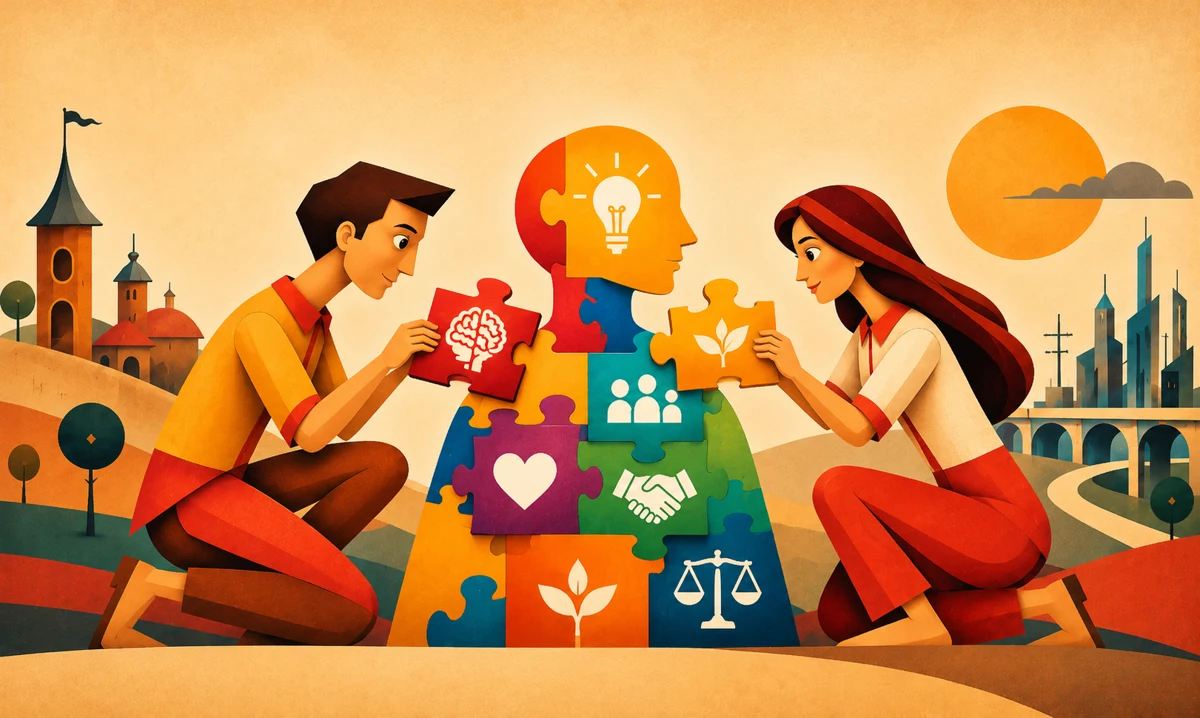
When we speak of a wiser, enlightened humanity, some will dismiss it as utopian. Perhaps perfection is unattainable. But should that prevent us from pursuing a more thoughtful, capable, compassionate and responsible civilisation?
A vision is not a guarantee of arrival. It is a guide for the choices we make, the systems we build and the values we practise. Without a direction worth pursuing, we risk accepting today's limitations as tomorrow's destiny.
HUMAN POTENTIAL
Every person has equal human dignity. But our capabilities, awareness, judgement and willingness to act responsibly are not developed to the same degree. Being born human does not automatically make us wise, empathetic, creative or capable of independent thought.
The abilities humans can develop.
The learning, reflection and practice that strengthen them.
The choices and contributions through which they become meaningful.
The distinction is about the development of capabilities, never the worth of a person.
CONSCIOUSNESS
Debates about AI often ask whether a machine can be conscious. That question remains unsettled. But it should not distract us from another question: how often do we consciously examine our own assumptions, habits, decisions and their consequences?
Consciousness as subjective experience is different from reflective self-awareness. Humans can be conscious while acting on habit, conformity, prejudice or impulse. Our opportunity is to become more deliberate in how we think, judge and act.
THE COMPARISON
We often describe humanity through its exceptional qualities: creativity, empathy, wisdom and judgement. But the best examples of human achievement do not represent everyone's everyday performance. Neither should a machine be judged only by its most impressive demonstration.
A fair comparison must consider actual tasks, demonstrated performance, uncertainty, limitations, context and consequences. Human excellence is a possibility to cultivate, not an assumption to take for granted.
A CONVERSATION
During a conversation about AI, a doctor suggested that humans would always be better at diagnosis. I asked him how many doctors in our district he considered truly excellent at diagnosing patients. His answer was fewer than one per cent.
That was one doctor's subjective impression, not a measured finding about the medical profession. Yet the exchange raised a useful question: when we say that a human is better, which human do we mean? The exceptional specialist, the average practitioner or the person still learning?
AI can make errors. So can clinicians. Medicine requires evidence, context, patient preferences, safety and accountability. The point is not to declare one side universally superior, but to ask what produces the best decisions and outcomes in a particular setting.
HUMAN GUIDANCE
It is often said that AI must remain under human guidance. But human guidance is not automatically wise. People can bring expertise, empathy and accountability. They can also introduce bias, complacency and poor judgement.
The challenge is therefore twofold: build AI systems that can be tested, questioned and governed responsibly; and develop humans who are capable of supervising, correcting and directing those systems wisely.
Transparent limits, evaluation, safeguards and accountability.
Competence, independent judgement, empathy and responsibility.
THE PATH FORWARD
Human evolution in this sense is not a biological ranking or a promise of perfection. It is the deliberate development of our abilities and the improvement of the environments in which they grow.
Becoming a wiser humanity begins in childhood. Education must nurture self-awareness, compassion and independent enquiry alongside knowledge and competence.
Free thinking, self-mastery, lifelong learning, compassion and personal responsibility.
Education reform, responsible institutions, enabling governance and leaders who develop more leaders.
Progress requires both. People must choose to grow, and our institutions must make growth possible rather than reward conformity.
A UTOPIA WORTH PURSUING
A perfect humanity may never exist. There will always be differences, contradictions and new challenges. But perfection is not the purpose of evolution.
Every independent mind, every act of compassion, every improvement in education and every responsible decision moves us towards a wiser humanity.